 WebMail
  LiveChat
  Support
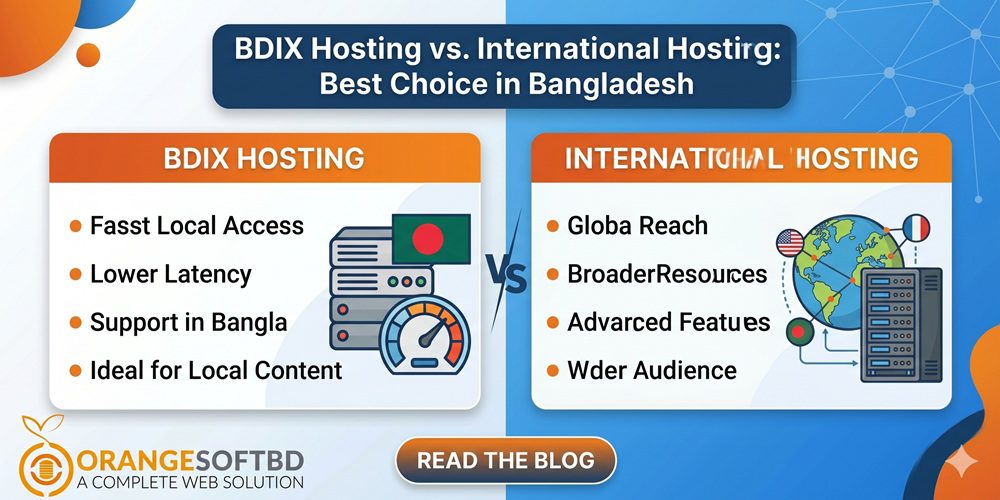
BDIX Hosting vs International Hosting: Best Choice in Bangladesh
Quick answer: BDIX hosting routes website data through the Bangladesh Internet Exchange, delivering 1–10ms latency for local visitors. International hosting routes traffic through submarine cables, producing 45–280ms latency for the same users. Choose BDIX hosting when 80% or more of the audience resides in Bangladesh; choose international hosting when traffic originates primarily from outside the country.
Selecting a hosting environment is one of the most consequential technical decisions a Bangladeshi website owner makes. Server location and network routing directly govern loading speed, user experience, search engine rankings, and operational cost. A website optimized for the wrong audience location loses visitors, sales, and search visibility before its content is ever read.
Two hosting models dominate the local market. The first is BDIX hosting, which connects a server to the Bangladesh Internet Exchange and keeps local traffic within national borders. The second is international hosting, which places a server in a foreign data center—commonly in Singapore, Germany, the Netherlands, the United States, or the United Kingdom—and routes traffic across global infrastructure.
This guide examines the differences between BDIX hosting and international hosting in detail. It covers network routing, speed benchmarks, SEO impact, security infrastructure, pricing, and the website categories best suited to each model. The objective is to provide a data-driven framework that website owners, bloggers, eCommerce businesses, agencies, startups, and developers can apply to their specific circumstances.
What Is BDIX Hosting?
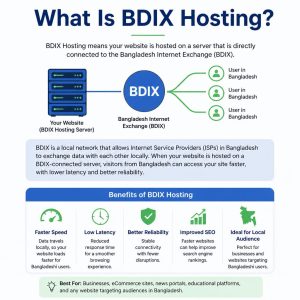 BDIX hosting is a category of web hosting in which the server connects directly to the Bangladesh Internet Exchange (BDIX), the primary internet exchange point in the country. BDIX interconnects more than 3,500 Internet Service Providers, mobile operators, and data networks, allowing them to peer with one another directly inside Bangladesh.
The defining characteristic of BDIX hosting is localized data routing. When a visitor on a local ISP requests a page hosted on a BDIX server, the data does not travel to foreign routing servers. Instead, it stays within the national network and reaches the visitor over a path that typically spans fewer than 50 kilometers.
Key attributes of BDIX hosting include:
- Local peering. Direct ISP-to-ISP connections eliminate the international detour that previously routed local traffic through Singapore or the United States.
- Reduced network hops. A BDIX request commonly completes in three to four hops, compared to fifteen to twenty-five hops for an international request.
- Ultra-low latency. Local latency frequently drops below 10 milliseconds.
- Submarine cable independence. A BDIX-hosted site remains accessible to local users even when international submarine cables experience disruptions.
For websites whose primary audience lives in Dhaka, Chittagong, or elsewhere within Bangladesh, BDIX hosting provides a measurable speed advantage that international servers cannot match for local traffic.
What Is International Hosting?

International hosting is a category of web hosting in which server space is rented from a data center located outside Bangladesh. Providers operate facilities in established technology hubs, and the most common locations serving Bangladeshi customers are Singapore, Germany, the Netherlands, the United States, and the United Kingdom.
When a visitor in Bangladesh requests a page hosted on an international server, the data travels through underwater fiber-optic cables and passes through multiple routing points before reaching the screen. This physical distance introduces latency for local users, but the model delivers advantages built for a global audience.
Key attributes of international hosting include:
- Global infrastructure. Tier-3 and tier-4 data centers provide redundant power, advanced cooling, and high-capacity network connectivity.
- Massive bandwidth. Global providers offer extensive—often unlimited—bandwidth at competitive price points.
- Balanced global access. A site hosted internationally serves visitors across multiple countries with reasonably consistent performance.
- Enterprise-grade reliability. High-tier facilities advertise uptime guarantees of 99.99% supported by hardware redundancy.
International hosting suits organizations whose business model looks outward, where visitors are distributed across several regions rather than concentrated inside Bangladesh.
How Website Traffic Travels: BDIX vs International

Understanding the performance gap requires understanding the route data takes between a server and a visitor. The two models follow fundamentally different paths.
How does international routing work for Bangladeshi visitors?
An international request follows an extended path. The visitor’s request travels from the device to a local ISP, then across a submarine cable to the foreign data center, and the response returns along the same route. A request to a Singapore server covers more than 6,000 kilometers in each direction. This journey involves fifteen to twenty-five network hops and introduces latency ranging from 45 milliseconds for Singapore to over 250 milliseconds for the United States East Coast.
How does BDIX routing work?
A BDIX request follows a compressed path. The visitor’s request travels from the device to a local ISP, through the BDIX exchange, to the server, and back. The entire journey usually stays under 50 kilometers and takes three to four hops. BDIX achieves this through the Border Gateway Protocol with local route preferences, which instructs ISPs to prioritize domestic routes over international ones.
The practical consequence is significant. A traceroute to a Singapore server commonly records 102 milliseconds across six or more hops, while a traceroute to a BDIX server records 7 to 9 milliseconds across three to four hops. This difference translates into faster Time to First Byte, more stable connections, and lower packet loss. International routes record 0.5% to 2% packet loss during peak hours, whereas BDIX routing records less than 0.1%.
Speed Comparison: BDIX Hosting vs International Hosting
Speed is the most pronounced difference between the two models for local visitors. The following table summarizes measured performance characteristics.
Performance Factor | BDIX Hosting | International Hosting |
|---|---|---|
Average Latency (local users) | 1–10ms | 45–280ms |
Local User Page Load | 0.5–2s | 2–5s |
Global User Speed | Slower | Fast to moderate |
Page Load Time (after migration) | As low as 0.8–0.9s | 3.1–4.2s |
CDN Dependency | Low for local traffic | Higher for balanced global delivery |
Network Stability | Submarine cable independent | Dependent on international cables |
Cost Efficiency (1TB transfer) | 2,000–4,000 BDT | 12,000–18,000 BDT |
Two documented migrations illustrate the impact. A Dhaka-based clothing store hosted in Singapore recorded a 4.2-second load time and a 73% bounce rate. After migrating to BDIX hosting, load time fell to 0.8 seconds and conversions rose 62% within three weeks. Separately, a Bangladeshi news portal that moved from Mumbai to BDIX in September 2024 reduced page load from 3.1 seconds to 0.9 seconds, cut server response from 180 milliseconds to 8 milliseconds, and expanded concurrent user capacity from 2,500 to 12,000 while monthly cost dropped from $280 to $45.
SEO Impact: Does Hosting Location Affect Rankings?

Hosting location influences search rankings indirectly, through performance signals rather than through geography alone. The relationship operates through several mechanisms.
How does page speed affect Core Web Vitals?
Google evaluates pages against Core Web Vitals, a set of user-experience metrics. Largest Contentful Paint (LCP) should occur within 2.5 seconds; BDIX hosting commonly delivers LCP under 1.0 seconds for Bangladeshi users. Interaction to Next Paint (INP) benefits from low latency, and BDIX keeps INP under 100 milliseconds. Faster Time to First Byte further supports favorable evaluation, with BDIX delivering 5–30 milliseconds against 200 milliseconds or more for international servers.
How does load speed affect bounce rate and conversions?
Bounce rate correlates strongly with load time. Pingdom research from 2024 records a 9% bounce rate for pages loading in 0–2 seconds, a 32% bounce rate at 3–5 seconds, and a 90% bounce rate beyond 5 seconds. BDIX hosting keeps local visitors inside the 0–2 second range. Conversion data reinforces the pattern: Amazon found that every 100 milliseconds of latency costs 1% in sales, and a documented client improved conversion from 1.8% to 2.9% after migrating to BDIX with hosting location as the only changed variable.
What does hosting location not do for SEO?
Hosting location does not directly rank a website. Google ranks pages on user-experience metrics and content quality, not on server coordinates or port speed. BDIX hosting improves rankings only insofar as it improves measurable performance for the local audience. A tracking study of 25 Bangladeshi eCommerce sites over six months recorded BDIX-hosted sites ranking 3.2 positions higher for local commercial keywords—an outcome attributable to speed, not to location as an independent ranking factor.
Security Comparison
Security infrastructure differs between the two models, primarily as a function of data center tier and provider scale.
- DDoS protection. International data centers typically provide enterprise-grade DDoS mitigation networks. Reputable BDIX providers offer firewalls and protective measures, though capacity varies by provider.
- Data privacy. Local hosting keeps data within national jurisdiction, which can simplify compliance for organizations subject to domestic data-handling expectations. International hosting places data under the jurisdiction of the host country.
- Backup infrastructure. Global facilities commonly feature automated, geographically distributed backups. Local providers offer backups, but redundancy depth depends on the individual operator.
- Disaster recovery. Tier-3 and tier-4 international facilities maintain advanced disaster-recovery systems with redundant power supplies. Local data centers have improved substantially, though some remain exposed to power-grid fluctuations.
- Physical server security. Top-tier international facilities maintain certified physical access controls. Reputable local providers maintain controlled environments, with standards varying across operators.
The security is therefore not the exclusive province of either model. A well-administered BDIX server with firewalls, malware scanning, and SSL certificates can be secure, while an unmanaged international server can be vulnerable. Provider quality matters more than location.
Cost Comparison
Cost structures diverge between the two models, and the relevant comparison depends on the audience the website serves.
- BDIX hosting pricing. Local providers offer competitive packages tailored to the domestic market, with generous local bandwidth allowances. Data transfer of 1TB commonly costs 2,000–4,000 BDT.
- International hosting pricing. Global providers leverage scale to offer extensive—frequently unlimited—bandwidth and storage at low advertised prices. Comparable 1TB transfer pricing reaches 12,000–18,000 BDT in equivalent local-traffic scenarios.
- Hidden costs. International hosting may require a content delivery network to achieve acceptable local speed, adding to total cost. BDIX hosting may require a CDN to serve international visitors. A hybrid BDIX-plus-CDN configuration commonly runs 3,500–5,000 BDT per month.
- Value analysis. For local-traffic websites, BDIX hosting delivers superior speed at lower data-transfer cost. For global-traffic websites, international hosting delivers broader reach and bandwidth that justify its pricing.
The lower-cost option is the one aligned with the audience. Paying for global bandwidth to serve a local audience wastes resources, and paying for local optimization to serve a global audience sacrifices reach.
Which Hosting Is Better for Different Types of Websites?

The optimal choice depends on the geographic distribution of the audience. The decision can be framed as two conditional recommendations.
When should a website use BDIX hosting?
Choose BDIX hosting when the audience resides almost entirely within Bangladesh. This model suits:
- Local news portals that serve high concurrent traffic to domestic readers.
- Local business and corporate websites targeting domestic customers.
- Educational platforms including school portals and result-checking sites for Bangladeshi students.
- Local eCommerce stores delivering exclusively within Bangladesh, where faster page speed reduces cart abandonment.
- Government-related and job-portal services focused on the domestic market.
When should a website use international hosting?
Choose international hosting when the business model looks outward. This model suits:
- SaaS products with a worldwide user base require responsive dashboards across regions.
- International blogs targeting readers in the United States or Europe.
- Global eCommerce stores shipping to multiple countries.
- Multi-country applications that require balanced performance across several markets.
- Freelancers and agencies serving international clients.
A hybrid configuration—BDIX hosting paired with a global CDN such as Cloudflare—suits websites with significant traffic from both local and international audiences.
Pros and Cons Table
BDIX Hosting | International Hosting | |
|---|---|---|
Pros | Ultra-low local latency; lower local data-transfer cost; submarine-cable independence; local support in Bengali within local business hours; strong local SEO performance | Balanced global access; high uptime guarantees; massive scalability; enterprise-grade security and DDoS protection; extensive bandwidth |
Cons | Slower for international visitors; redundancy depth varies by provider; exposure to local power-grid fluctuations | Higher local latency; higher local data-transfer cost; CDN often required for acceptable local speed; data held under foreign jurisdiction |
Common Myths About BDIX Hosting
Several persistent misconceptions distort the hosting decision. Each warrants correction.
- Myth: BDIX hosting automatically improves SEO. BDIX hosting improves SEO only by improving performance metrics for local users. It is not an independent ranking factor, and a slow, poorly optimized BDIX site will not rank well.
- Myth: International hosting is always faster. International hosting is faster only for visitors physically closer to the foreign data center. For Bangladeshi users, BDIX hosting is 70–85% faster.
- Myth: BDIX hosting cannot handle large traffic volumes. A single 1Gbps dedicated BDIX connection supports 5,000–10,000 concurrent users for a typical 3MB page. High-traffic news portals scale to 10Gbps when sustained demand requires it.
- Myth: International hosting is always more secure. Security depends on provider quality and server administration, not on location. A well-managed BDIX server with firewalls, malware scanning, and SSL is secure.
Real-World Scenarios
The following scenarios illustrate how the decision applies in practice.
- Scenario 1: Dhaka clothing retailer. A clothing store serving domestic buyers migrated from Singapore to BDIX, reducing load time from 4.2 seconds to 0.8 seconds and increasing conversions 62% in three weeks. BDIX hosting is the correct choice.
- Scenario 2: National news portal. A news site requiring high concurrent capacity moved from Mumbai to BDIX, cutting load time to 0.9 seconds and expanding capacity to 12,000 concurrent users while lowering monthly cost. BDIX hosting is the correct choice.
- Scenario 3: SaaS startup with global users. A SaaS platform serving customers across North America and Europe requires low latency for those regions. International hosting, optionally paired with a global CDN, is the correct choice.
- Scenario 4: Bangladeshi blog with mixed readership. A blog with substantial domestic traffic and a growing international following benefits from a hybrid configuration—BDIX hosting with Cloudflare CDN—to serve both audiences.
- Scenario 5: Local educational result-checking portal. A platform serving Bangladeshi students during peak result-release periods requires low local latency and high concurrent capacity. BDIX hosting is the correct choice.
Frequently Asked Questions
Is BDIX hosting better than Hostinger?
For an audience based in Bangladesh, BDIX hosting delivers lower latency—1–10ms compared to the higher latency of an international provider serving Bangladesh from a foreign data center. Hostinger and similar international providers deliver stronger global performance and broader infrastructure. BDIX hosting is better for local traffic; international providers are better for global traffic. The audience location determines the better option.
Does BDIX hosting improve SEO?
BDIX hosting improves SEO indirectly by improving page speed, Core Web Vitals, and bounce rate for local users. It is not a direct ranking factor. A tracked group of Bangladeshi eCommerce sites ranked an average of 3.2 positions higher for local commercial keywords after benefiting from BDIX speed, an outcome driven by performance rather than location alone.
Is BDIX hosting suitable for WordPress?
Yes. BDIX hosting supports WordPress in the same way international hosting does. For a WordPress site serving a Bangladeshi audience, BDIX hosting accelerates page loads and reduces server response time, which benefits both user experience and search performance. Quality hardware, smart caching, and optimized images remain necessary regardless of location.
Can international visitors access BDIX-hosted websites?
Yes. A BDIX-hosted website connects to the global internet and is accessible from any country. International visitors may experience slower load times than local visitors because their requests travel a longer route. Pairing BDIX hosting with a global CDN mitigates this for sites with international audiences.
Is BDIX hosting cheaper?
For local-traffic websites, BDIX hosting is generally cheaper on a data-transfer basis—approximately 2,000–4,000 BDT per 1TB compared to 12,000–18,000 BDT for equivalent international transfer serving local users. International hosting can appear cheaper through unlimited-bandwidth plans, but achieving comparable local speed often requires an additional CDN cost.
Final Verdict
The decision between BDIX hosting and international hosting reduces to a single question: where does the audience live? BDIX hosting delivers 1–10ms latency, sub-second local page loads, lower local data-transfer cost, and submarine-cable independence for websites serving Bangladesh. International hosting delivers balanced global access, enterprise-grade infrastructure, and extensive bandwidth for websites serving a worldwide audience.
The evidence supports a clear framework. Select BDIX hosting when 80% or more of traffic originates within Bangladesh, as documented migrations show measurable gains in speed, conversions, and concurrent capacity. Then select international hosting when the majority of traffic originates abroad. Select a hybrid BDIX-plus-CDN configuration when traffic is meaningfully split between local and international audiences.
Two actionable steps follow from this analysis. First, verify any provider’s BDIX claim with a traceroute test—genuine BDIX hosting shows only local hops and a ping under 15 milliseconds. Second, match the hosting model to the audience rather than to the advertised price, because performance aligned with the wrong audience location delivers no value. Choosing on this basis ensures that the hosting environment serves the visitors who matter most.


